
Humming that gets louder with speed?
A hum or drone that rises with road speed, and stays the same whether you press the gas or lift off, is most often a worn wheel bearing or unevenly worn tires. The bearing is the more urgent one: it gets louder over weeks, and left too long it can seize or let the wheel come loose. Cupped tires make a similar hum and are mostly a comfort and cost problem. Here is how to tell the two apart, when it is still safe to drive, and what each fix costs.
Safety first
Can I still drive?
- Drive normally, book a check
A faint, steady hum only at highway speed, the same on every drive. The car tracks straight, nothing shakes, no warning light. Often tire wear, sometimes an early bearing. Normal speeds are fine; have the tires and bearings checked in the next week or two.
- Get it checked this week
The hum changes when you turn or change lanes, it has grown louder over the last few weeks, or it comes with a slight vibration or an ABS or traction light. That points to a wheel bearing. Drive gently, skip long highway trips, and have it inspected in the next few days.
- Stop driving
A grinding or growling at any speed, a wobble or shake you can feel, steering that feels loose or pulls to one side, a wheel that is hot after a drive, or a noise that got much worse in one day. Pull over where it is safe and get help. A bearing in this state can seize or let the wheel separate from the car. Have it towed instead of driving on.
Narrow it down
When do you hear it?
| When you hear it | What it usually points to |
|---|---|
| A steady hum or growl that rises with road speed, the same whether you accelerate or coast | A wheel bearing or uneven tire wear, the two most common causes. The rows below separate them. |
| It changes when you turn or change lanes, louder one way than the other | A wheel bearing. The weight shifts in a turn, so the noise often gets louder when you turn away from the bad side. |
| A rhythmic hum or thump that changes with the pavement, and the tread has scooped dips | Cupped or unevenly worn tires, often from worn shocks or struts, a bad alignment or an unbalanced wheel. |
| The hum follows engine speed, or changes when you lift off the gas or shift | More likely the driveline than the wheels. A shop test drive sorts that out. |
| Hum plus a vibration in the steering wheel or the seat at highway speed | A bearing with play in it, or an unbalanced or badly worn tire. |
| The hum, and now the ABS or traction light is on | A loose bearing can upset the wheel speed sensor next to it. Have the bearing checked, not just the sensor. |
| Grinding, a wobble you can feel, loose steering, or a hot wheel | A bearing close to failing. Stop driving on it. |

Listen
What it sounds like
A worn wheel bearing makes a low, steady hum, growl or rumble, a bit like driving on a rumble strip or the drone of a helicopter. It usually starts at town speeds, rises in pitch and volume as road speed goes up, and does not change when you lift off the gas. In a turn it often gets louder or quieter as the weight shifts.
Uneven tire wear sounds similar but more rhythmic, like a tread block slapping the road, and it often changes with the pavement.
Check it yourself
What you can check yourself
Do
Parked on level ground, engine off, tires cool:
- Run your hand over each tire. Feel along the tread for scooped dips every few inches or saw tooth edges. That is cupping, and it alone can explain the hum.
- Check the tire pressure. Too low or too high wears tires unevenly and makes them louder. The right pressure is on the sticker in the driver door opening.
- Note what changes the noise. From what speed? Louder in left turns or right turns? Different when you lift off the gas? A mechanic will ask exactly that.
- Watch the dashboard. An ABS or traction control light together with the hum points to a loose bearing next to the wheel speed sensor.
Please don't
Four things to avoid:
- Swerve or weave on the road to test it. Listen during normal turns and lane changes only. A shop confirms it on a lift in minutes.
- Jack the car up to rock the wheel yourself. Checking bearing play means a wheel off the ground. Without proper stands and experience, leave that to a shop.
- Take a long highway trip to see if it gets worse. Highway speeds load a worn bearing hardest and can push it to fail sooner.
- Touch the wheel hub or the rotor after a drive. A failing bearing runs hot. Let it cool first.
A shop checks bearing play and the tread in a few minutes, often as part of a free tire inspection.
How a wheel bearing wears
Built for 100,000 miles, unless the road says otherwise
- 60,000 to 100,000miles before a bearing usually shows wear
- Potholes and waterare what shorten that life
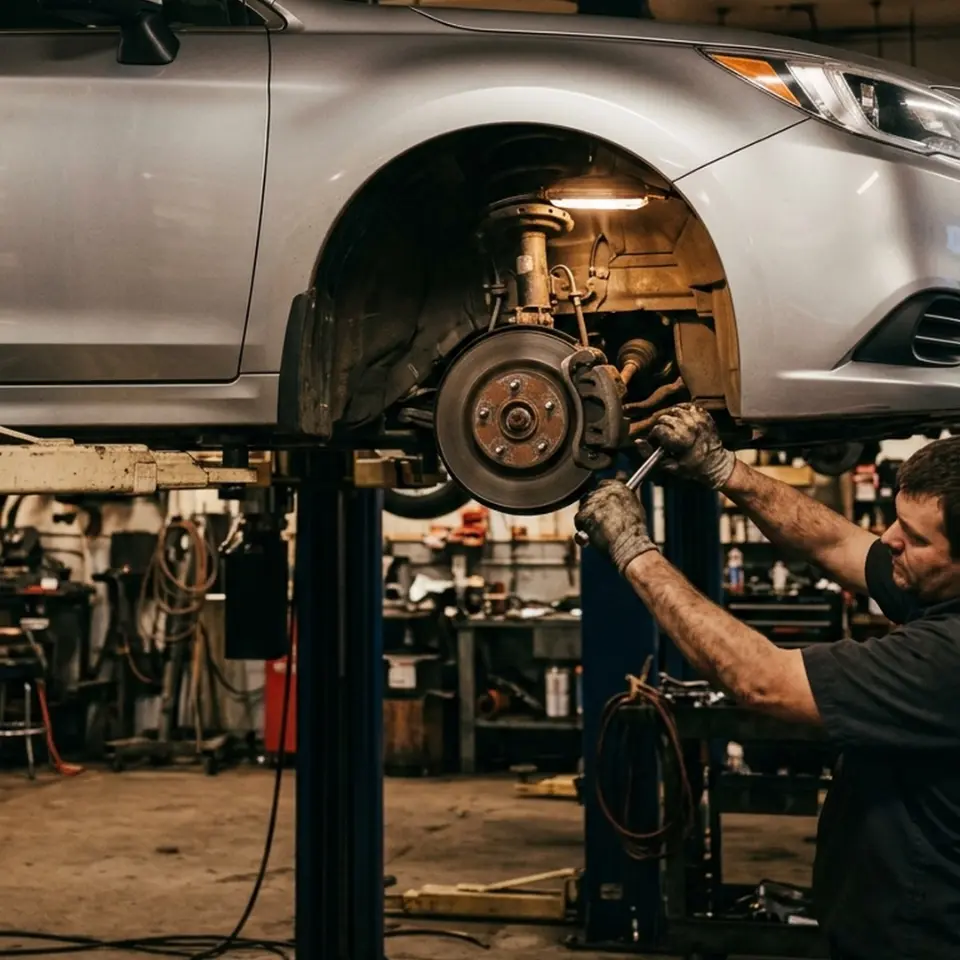
A wheel bearing is a ring of steel balls or rollers packed in grease, built to last around 100,000 miles. Hard pothole hits, curb bumps and speed bumps taken fast damage it, and water, salt or grit past the seal spoils the grease. From then on it wears faster and starts to hum.
Costs
What the repair usually costs
US averages, 2026, for one wheel. Prices vary a lot by car and region, and by whether the bearing is pressed in or comes as a complete hub.
| Repair | Part | At a shop, part and labor |
|---|---|---|
| New wheel bearing, one wheel | about $120 to $400 | about $350 to $650 |
A pressed in bearing is a cheaper part with more labor; a complete hub assembly costs more but is quicker to fit. Luxury and electric models often run $700 and up. Cupped tires mean new tires plus whatever wore them: an alignment, a balance or worn shocks.
Record it
How to record it
Only if the car is safe to drive. At the stop level above, do not drive it for a recording. Describe the noise in words instead.
- Let a passenger hold the phone.The driver never handles the phone while driving. No passenger? Mount the phone and start recording before the car moves.
- Pick a quiet, straight road.Radio and fan off, window down on the side the noise seems to come from. Drive at the steady speed where you hear it, within the limit.
- Ten to twenty seconds is enough.Hold the speed, lift off and coast a little, then take a normal, gentle curve. Say out loud what you are doing: "45, steady", "coasting", "turning left".
- Note when it startedand whether it changes in turns, with the pavement, or with engine speed.
Get the likely cause for your car
Car Whisperer is an AI mechanic on your iPhone. Add your car, record the hum at a steady speed and through one gentle turn, and add a line about when it started. In seconds you get the likely cause, the checks that separate a bearing from a tire, and what a wheel bearing should cost for your car.

It doesn't plug into your car and it can't feel play in a bearing or measure your tread. A shop with a lift does that in minutes. Car Whisperer tells you what is likely, what to check and what to ask.
FAQ
Questions
What does a bad wheel bearing sound like?
A low, steady hum, growl or rumble that starts at town speeds and gets louder and higher as you go faster. It stays the same when you lift off the gas and often changes when you turn. Later it can turn into a grinding or a wobble.
How do I know if it is the wheel bearing or the tires?
Listen in turns and feel the tread. A bearing hum usually changes when you turn or change lanes. Tire noise is more rhythmic, changes with the pavement, and the tread often has scooped dips you can feel. A shop settles it by checking the bearing for play with the wheel off the ground.
Is it safe to drive with a humming wheel bearing?
For a short time at normal speeds, if it is only a hum. Book an inspection this week and skip long highway trips. Grinding, a wobble, loose steering or a hot wheel mean stop driving: a bearing that fails can seize or let the wheel come off.
How much does it cost to replace a wheel bearing?
For most cars, about $350 to $650 for one wheel at a shop, with the part at about $120 to $400 depending on whether it is a pressed in bearing or a complete hub. Luxury and electric models often run $700 and up. Bearings are usually replaced one at a time.
Keep reading